

It started with a watch I couldn't afford to replace.


My first mechanical watch was a Seiko SKX007. I wore it daily and loved everything about it, but after a few months I wanted something different. As a college student, buying another watch wasn't realistic. My brother, who worked at a high-end jewelry store, told me to try changing the strap instead — and to look for one made with Horween leather.

That sent me down a rabbit hole. I was studying business, looking for something tangible to build, and missing the kind of physical work I grew up doing. When I saw what handmade leather straps cost — and how few of them actually lived up to the price — I decided to try making my own.

The first straps were rough. I thinned leather by hand with an X-Acto knife. The stitch spacing was uneven. I wasted more material than I used. But the process felt right, and every mistake pointed toward a better way to do things.
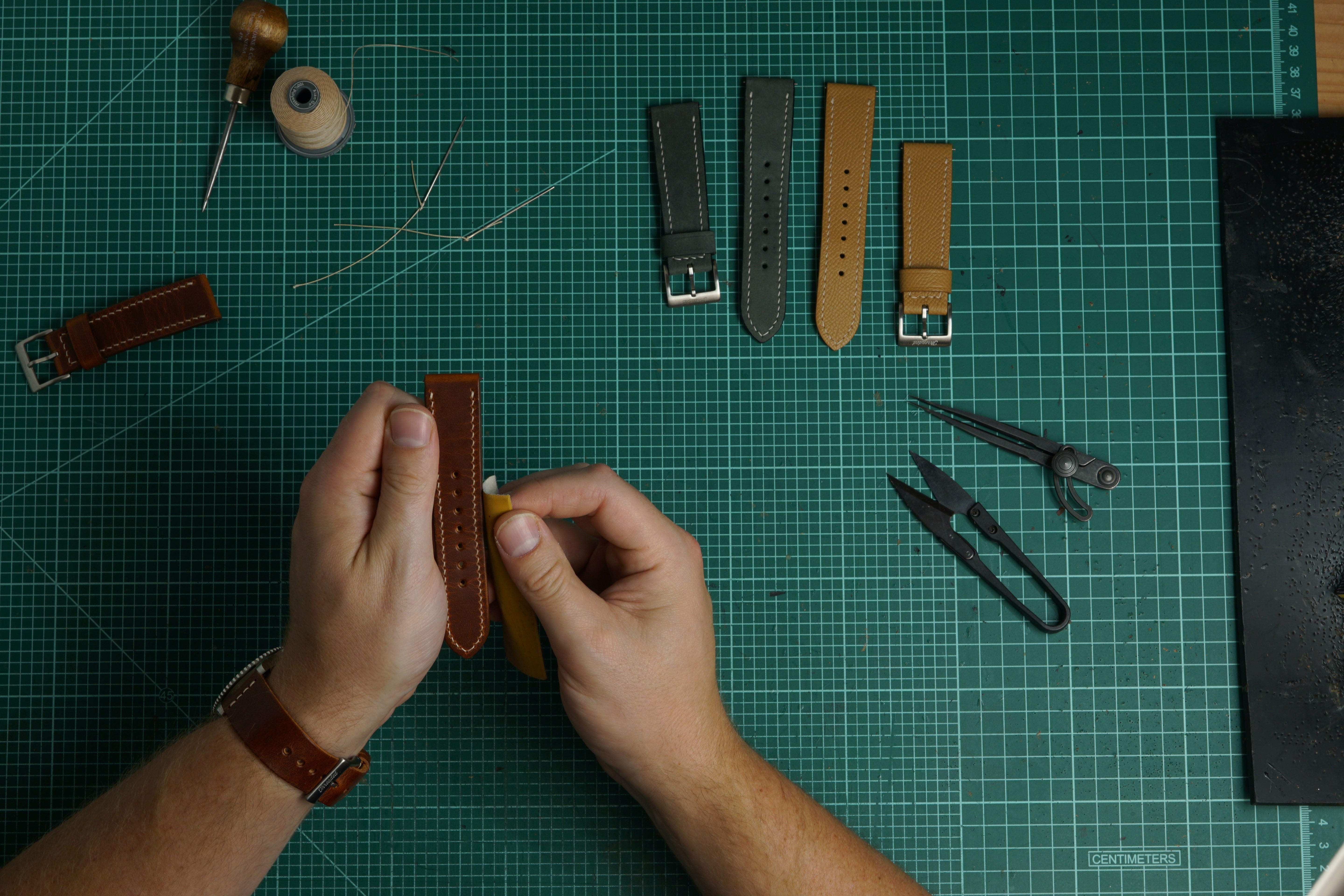
 

Every strap is hand stitched. Every one.


Every strap is hand stitched — not fed through machines, but stitched by hand from start to finish — with a durable, braided waxed polyester thread. Hand stitching is slower than machine stitching, but the difference is structural — the thread wraps continuously around the leather instead of locking at a single point. If a stitch breaks, the rest hold. No machine marks, no shortcuts, no glued edges.

Our process has changed a lot since those early days. We invested in proper skiving equipment, refined our edge finishing, and developed stitch profiles for each strap style. But the foundation hasn't changed: our strapmakers are trained on the same standards and techniques I developed from day one. They're exceptional — and every strap is still built one at a time, checked by more than one set of hands before it ships.

Every strap represents hours of work, years of iteration, and a refusal to cut corners.

— JAMES, FOUNDER

Sourced from tanneries trusted by the world's finest luxury houses.

We hand-select leather from a small number of heritage tanneries — places where the process hasn't been compressed or industrialized. Horween Leather Company in Chicago, operating since 1905. Conceria Walpier and Badalassi Carlo in Tuscany. Tanneries Haas in Alsace, France.

These are full-grain, minimally processed leathers built to age honestly. They develop patina, soften with wear, and become unique to the person wearing them. That's not a defect — that's the point.

A watch strap gets more contact with your skin than almost anything you own. The leather matters. We choose tanneries that use traditional methods — bark retannage, vegetable tanning, hand-applied finishes — because the result is a leather that responds to you. Scratches blend. Color deepens. After a few weeks on your wrist, it won't look like anyone else's.

Made in the USA

Every leather strap is cut, stitched, and finished by hand in Sandy, Utah. We do not outsource.

Quality Over Speed

Each strap is checked by more than one set of hands before it ships. Scaling never means shortcuts.

We Stand Behind It

Not happy? We'll cover return shipping and send a replacement, a different style, or a full refund. No questions.

We'd Love to Hear From You

Whether you need help choosing a strap, want to discuss a custom order, or just want to geek out about your collection — we're always happy to hear from you.

hello@threadedleather.com